for the past couple weeks the team and i have been working hard getting our multitouch video/installation/performance interface to an alpha state, and meet our march 12th deadline. this has definitely been the most difficult personal project i have worked on, as i feel much of the development depends of the diverse skills, knowledge and background of my teammates. some of the hardest decisions to make are simply to trust in the opinions, skills and knowledge that my teammates bring to the project. no longer something i can consider mine, the project has become a great example of the co-creative process. we are not working with the market in mind, but to simply get a chance to work together with good people and have fun doing something we are all interested in.
the project is defined by three key elements. these elements are the hardware design, the software design, and the usability and performative aspects. each element is highly reliant on the other, and i really have no idea how i would have gotten this far if it wasn’t for the excellent, dedicated and incredible people i am collaborating with.
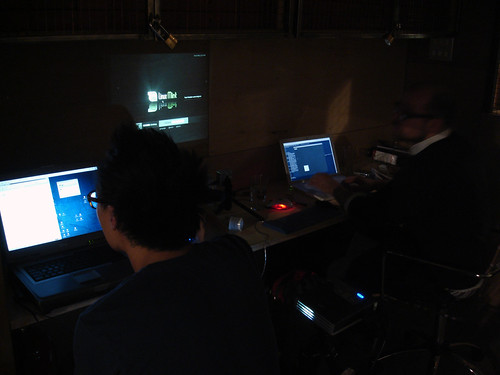
in terms of software and usability, Jan and Martin; our dynamic duo of software developers, spent the weekend setting up the essential underpinnings and infrastructure of the Stutterbox interface. working with our user Crystal; who is a talented designer, video performance artist and fellow MACPNE colleague, we continued to iron out the metaphors we will use for the interface and address the critiques and suggestions raised during the course of its development and production.
at the moment we are trying to blend the VJ workspace with the actual performance output display. by making a hybrid interface between workspace and output, Crystal will be able to construct her performance narratives in the same area where the story would unfold for the audience. this somehow reminds me of the process of making graffiti, as in graffiti the inspiration, workspace and gallery end up being the same place. as graffiti artists make the urban environment all three places at once, so should our multitouch interface.
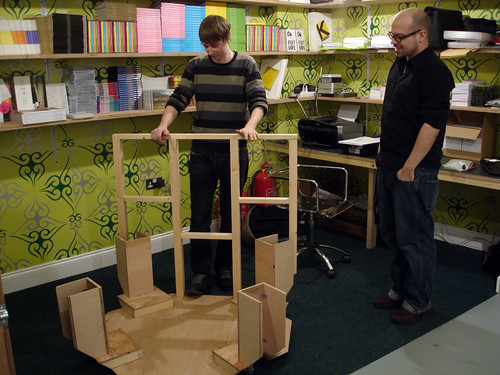
regarding hardware, Adam and i are now at the stage of putting everything together we made in the woodshop last week. Adam is my oldest friend (we’ve been friends for something like 15 years!) who came over from toronto via berlin to help me out. he happens to be a talented industrial designer and it shows in the craftmanship of the design and construction of the table. it really is well (if not over!) built.
in order for us the have full, 24h access to the table, we have moved much of the hardware to KKOUTLET so we can continue building without the encumbrance of closing times and security guards, which we were running into working at CSM. at the moment we are around 75 percent done with the construction, and hope to begin to drop in the electronics by wednesday.
in the span of just a few days, 2 places that are close to me will never be the same.
after coming back from a friends’ birthday, karin, adam and i found ourselves standing outside camden station, just beyond the camden lock, watching blooms of smoke hit the sky. we had to make a lengthy detour to get home. looking at my phone when i reached my bed, i realized that i missed an sms from the neighbors. all it said was “camden is on fire!“.
Namdaemun gate in Seoul, South Corea is the oldest piece of history in the country. i have been working on a project with the city involving the ancient city walls, and the south gate once marked the entrance to the old city. recently opened to the public again, its burning marks a major blow to the historical commodity of the culture and nation. this also forces us who are working on the project to rethink the relevance of our proposals after such a tragic event.
no matter how far we have progressed, no matter how far technologically has advanced, no matter how morally enlightened we may become, fire always wins.
Once again proving the need for good, free parties in east London, kesselskramer stirred it up nicely this past friday night with nothing less then an old school house party at the opening event of KK OUTLET. What could be described as the “victorian cottage” to the agency’s deconsecrated church headquarters in Amsterdam (no seriously, it’s a church, which is why it’s not in parenthesis), KK OUTLET is store, gallery and office rolled into one. this three-prong smorgesboard of kung fu style provides new synergies between disciplines and practices, to offer unique solutions for unique briefs and clients.
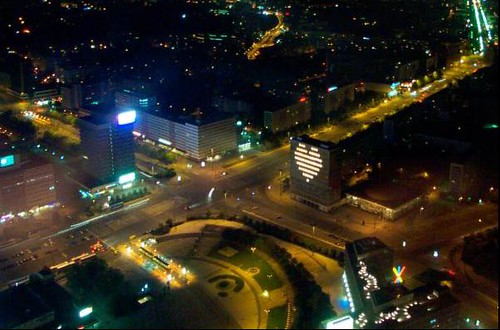
Seoul already pays much attention to lighting within the city, although projects seem to be lucid and playful now, a citywide plan or theme could provide continuity and strong identity. the first example of program for city lighting is alexanderplatz in berlin, where the ccc has been known to do their blinkenlights project:
next up is the SPOTS media facade in berlin, potsdamerplatz:
also on continental europe, rotterdam’s kpn building:
Green-Spaces
here’s a look at singapore. notice its concentration of green space in the heart of the city.
london’s green spaces are also mostly concentrated into key areas.
this differs compared to the cities of muenster and naarden, where green-space becomes a gesture of the former city wall within the urban planning.
this layout provides accessibility to green-spaces by a wider radius of city dwellers. If Seoul would adopt this continental european urban planning trend, It could provide for the city a common cross-section of park-space that links districts with automobile-alternative access. People could bike and walk from district to district within the park ring. An electric tram system or maglev train would be cool too…
Green-space within the city is freed from privileged neighborhoods and becomes accessible by all points of the city. for tourists and locals alike, it would activate the city wall as a monumental geographical feature for way-finding within the inner city.
monday marked a milestone of good intentions, as 2nd year students from the 2008 graduating (pending) class of my MA degree hosted schematic proposals for our final project. i was lucky enough to grab a good spot to present (last before the first brake) but was still stoopid nervous at trying to pitch my project in front of both years of the program, the program director, the guest critique tutor and our 4 project tutors.
the projects were pretty interesting, and it’s good to see that most of the projects are developing quite nicely. people seem to have solidified their concepts and there appears to be an end in sight!
some of the projects included a psycho-geographical atlas, a ceramic tile that gets worn away with the passage of people to reveal evolving content, the future of outdoor media, emergency shelters that are customizable to the typology of refugee, an allegorically immersive museum installation of baroque carriages for the pope, a user-design led participatory show, an engaging workshop that reaches out to the muslim communities in london, an urban installation that addresses the feeling of danger and security in hackney, a workshop that gets artists and architects to understand how to collaborate, an edible garden, and many, many other insightful projects.
and my project? i will hopefully get to work with some inspiring people to develop a grassroots oriented, multitouch interface. if you are interested, here is the link to a pdf of my presentation.
it’s hard to draw lines. no, i don’t mean lines that make drawings. i am talking about the virtual lines and psycho-geographical boundaries we make for ourselves and the world around us. now that kairn and alex have joined me in rotterdam, our internship is in full swing. it seems like we have been working on this together for months already…
on order for us to digest the massively huge amount of data that AMO has produced over the years, we came up with a simple but effective way to quantify the ideas, concepts, themes and typologies. here is a short video that we produced during our first week of research. enjoy!
look away! nothing to see here! whatever you thought you read, you didn’t. just look over there at the pretty pictures of our ultra-bland and non-eventful stay in Rotterdam, where we concentrate on a job we truly love to do:
a few weeks ago i had a taste of life in rotterdam while working for the V2: Institute for Unstable Media. called in by my good friend and colleague danja, i had the opportunity to work in the “hack” department of the V2 Lab during this years DEAF07 and V2 25th anniversary events.
most of the work i did was of a technical nature, and involved climbing up to the tops of buildings fixing yagi antennae (all hail the mighty zip-tie!!!) to throw network accessibility wirelessly between the various locations of the festival. some buildings i am proud to say i stood on the roof of include Witte de With / TENT, NAi and of course the V2 building proper.
we also had to lay down quite a bit of patch cable (we were dropping CAT-5e like spidey slings web) and also deployed numerous wireless hotspots, computer terminals and workstations for visiting artists and other tech-monkee-ish jobs. even had a chance to VJ along side danja at unDEAF… that was cool.
one of the more mundane tasks i had to perform at the festival was to monitor audio and video live-streams that were being cast on the DEAF07 webpage. this involved sitting and watching and listening to lectures… which isn’t so bad until you realize that you have spent the entire day sitting in a dark hall staring at 4 or so monitors while outside it is immaculately sunny and 25 degrees.
what i did enjoy the most was getting to spend time with some sorely missed friends. sabruno and danja were kind enough to let me stay at their place during the duration of my contract with V2, and even though i was pretty tuckered out by the time we got home from work, we still managed to have that cozy feeling. eating good food and sitting in the twilight of the setting sun over the vista of rotterdam’s skyline, on top of bruno and danja’s building, drinking beer and fixing bikes, is my minds’ eye of the netherlands quintessential.
thanks to danja and bruno for putting up with me while i was in rotterdam and i can’t wait to come back this summer with karin and alex to begin work with OMA/AMO… w00t!
In 1982 Larry Dossey, an American physician, coined the term “time-sickness” to describe the obsessive belief that “time is getting away, that there isn’t enough of it, and that you must pedal faster and faster to keep up”.
Guy Claxton, a British psychologist, thinks acceleration is now second nature to us: “We have developed an inner psychology of speed, of saving time and maximising efficiency, which is getting stronger by the day”.
These comments and quotes motivated our group to base our final Unit 1 project on the new trend of ‘slow’ living; to ask ourselves whether conducting one’s day to day actions slowly genuinely promotes quality of life, and whether this quality can generate happiness and wellbeing.
Festina lente is the best way to describe the essence of all the movements which proclaim the need for people to slow down (Slow City, Slow Food, Slow Sex, Super Slow Exercise, Slow Dating, etc.). It is a phrase attributed to Svetonius and was often used by Caesar Augustus, and means to quicken slowly. The saying encapsulates numerous dichotomies, such as patience and urgency, velocity and flexibility, action and meditation. In the case of movements such as Slow Living, it refers specifically to a lifestyle which “respects tradition and quality, and seeks to use the best aspects of the modern world to enhance, preserve and enjoy the old ways of doing things, but not to the exclusion of progress and not for the sake of avoiding change”.
Our group’s idea was to create a video which would illustrate vividly this contrast which is now common in society between people who choose to slow down and people who continue fast-paced living, as well as seeing how people would react to our ‘slow’ intervention and seeing if it is true that British people are ever increasingly looking for ways to calm down modern life rhythms.
Our intervention comprised of an afternoon tea break taken along the river Thames at Southbank. Our group set up a table and held a proper and original afternoon tea party with a china set, scones and preserves, in order to raise awareness among those walking by so that they too should sit and take a break.
The choice of having a tea break as our intervention fell upon our desire to use something which is very close to the British people, so as to not only research into slow and fast perceptions of time but also on identity and traditions. As we researched into the history of tea, it became obvious to us that tea is extremely important to all cultures, from the Russian zavarka using tea to welcome guests into one’s home to the Moroccan mint tea served to cool down on hot days and facilitate social community.
Tea is the most consumed beverage in the world after water. It has taken on many forms and has much significance throughout history. It is a symbol of relaxation and generates social interaction.
BACKGROUND RESEARCH – TEA IN THE BRITISH CULTURE
AFTERNOON TEA or LOW TEA: A traditional afternoon tea is served between 3 PM and 5 PM at a low table. The menu consists of three courses-assorted crustless finger sandwiches and savouries, scones with Devonshire (clotted) cream and preserves and assorted finger sweets and petit fours. It is not uncommon for a trifle or dessert to add as a fourth course.
INFORMAL AFTERNOON TEA: Served in a salon or outdoor setting, with either placement seating or casual seating at low tables. Candles are never used.
(http://www.seedsofknowledge.com/teahistory.html)
Great Britain was the last of the great sea-faring nations to break into the Chinese and East Indian trade routes. The first samples of tea reached England between 1652 and 1654, and it quickly proved popular enough to replace ale as the national drink. Prior to the introduction of tea into Britain, the English had two main meals – breakfast and dinner: Breakfast was usually composed of ale, bread and beef, while dinner was a long, massive meal at the end of the day. It was without a doubt an impractical way of distributing food throughout the day and many often felt sluggish by mid-afternoon. It is said that it was the 7th Duchess of Bedford, Anna, who introduced the concept of afternoon tea, which included other than tea also small cakes and bread and butter. The novelty soon took on and it became almost immediately a very popular activity of the day. It was Queen Victoria who introduced the custom of adding lemon to tea, after visiting one of her daughters in Russia – before that, the English took only milk with their tea.
A common pattern of service soon merged. The first pot of tea was made in the kitchen and carried to the lady of the house who waited with her invited guests, surrounded by fine porcelain from China. The first pot was warmed by the hostess from a second pot (usually silver) that was kept heated over a small flame. Food and tea was then passed among the guests, the main purpose of the visiting being conversation.
Tea was introduced into the British culture as a time to meet friends, to relax and to regenerate.
RESULTS AND OBSERVATIONS
Our performance not only attracted many passers-by but also generated in us mixed feelings – though we felt that our actions were forcibly too slow, we felt as if we were practicing yoga: our breathing calmed down, our heart rate appeared to beat slower. Those who stopped to watch us were informed of our project and ask to contribute comments which we audio recorded. It is interesting to note that most people were pleased to watch us and almost observed us with envy, and when asked about what they thought with regards to ‘slow’ living, most responded that it was an unobtainable dream, that though they too wanted to slow down they felt that it was not possible. Few people said that they have recently made changes to their lifestyles, so as to include more quiet time or thinking time, by themselves or with their companions, but all stated that they were not yet satisfied with their quality of life. Most of those who responded positively to our questions were nevertheless in their mid-40s and they tended to stress the fact that their decision to change their lifestyles derived from years of fast-paced living.






 villainous.biz
You must be logged in to post a comment.