Skip navigation

Category Archives: projects

So as to follow up on the on-going antics of the gamelan gang, for the past few months the MACPNE department has been generating research and development that encompasses the design of a user experience and deployment of a pavilion to house the Indonesian instrument know as the gamelan. This commission is to coincide with the grand re-opening of the Royal Festival Hall and renewal of London’s Southbank Centre in mid-June of this year.
The gamelan is considered one instrument in Indonesian culture but when we got one delivered to our studio on the 9th floor of CSM’s Red Lion Square building a couple of months ago we discovered it was so much more then what we expected. as part of our research we were instructed in its playing by one of the UK’s premiere gamelan players and gamelan expert in residence at Southbank Centre, Sophie Clark.

A lil’ diddy about the gamelan; a complex collection of percussion instruments, the version of the gamelan we played (there are several different types of gamelans from the various island districts that Indonesia is comprised of) is considered the “portable” version. the full-size version of the gamelan maintained by southbank centre is housed in its own room within the Royal Festival Hall.

Gamelan music is composed of intricate patterns that are unique to the each part of the gamelan and is quite mathematical; Bach would have had a handful to deal with. Every gamelan is tuned within itself, so every gamelan sounds different from one another. Playing a composition on one set could sound drastically different on another, and often players learn all instruments and rotate so that everyone plays each part of the gamelan throughout a performance.

The gamelan is the centerpiece of local Indonesian community. most Indonesian people that live around a pendopo (a building that serves as something reminiscent to a town hall or community centre) learn how to play or at least have heard a gamelan before at one point or another. It is an important element in shadow puppet theater (called wayang) and as accompaniment to Indonesian dance and ceremony. It is used for old-school jammin’, too.

Within the pendopo, the gamelan is played at ground level where musicians sit alongside spectators on even ground. Gamelan sessions have the potential to last days, and often people come to the pendopo and eat with family and friends, converse with fellow community members and even take naps in the shade away from the heat. Everyone in the pendopo is barefoot, which adds to the general coziness of the atmosphere.

right… so back to the project, other research conducted included people flow studies, ethnographic research interviews with gamelan groups, visitors to Southbank Centre and local skateboarders at the skate park adjacent to the Royal Festival Hall, reading of the ancient texts the Ramayana and Mahābhārata and site visits to the rebuild / retrofitting of the Royal Festival Hall.

After a consultation with structural engineers, the final pitch will occur this Friday, a day after another crit for a project for the master-planning of the new Kings Cross Center in London.

I think it’s going to be yet another tough and exciting week.

In 1982 Larry Dossey, an American physician, coined the term “time-sickness” to describe the obsessive belief that “time is getting away, that there isn’t enough of it, and that you must pedal faster and faster to keep up”.

Guy Claxton, a British psychologist, thinks acceleration is now second nature to us: “We have developed an inner psychology of speed, of saving time and maximising efficiency, which is getting stronger by the day”.

These comments and quotes motivated our group to base our final Unit 1 project on the new trend of ‘slow’ living; to ask ourselves whether conducting one’s day to day actions slowly genuinely promotes quality of life, and whether this quality can generate happiness and wellbeing.

Festina lente is the best way to describe the essence of all the movements which proclaim the need for people to slow down (Slow City, Slow Food, Slow Sex, Super Slow Exercise, Slow Dating, etc.). It is a phrase attributed to Svetonius and was often used by Caesar Augustus, and means to quicken slowly. The saying encapsulates numerous dichotomies, such as patience and urgency, velocity and flexibility, action and meditation. In the case of movements such as Slow Living, it refers specifically to a lifestyle which “respects tradition and quality, and seeks to use the best aspects of the modern world to enhance, preserve and enjoy the old ways of doing things, but not to the exclusion of progress and not for the sake of avoiding change”.

Our group’s idea was to create a video which would illustrate vividly this contrast which is now common in society between people who choose to slow down and people who continue fast-paced living, as well as seeing how people would react to our ‘slow’ intervention and seeing if it is true that British people are ever increasingly looking for ways to calm down modern life rhythms.

Our intervention comprised of an afternoon tea break taken along the river Thames at Southbank. Our group set up a table and held a proper and original afternoon tea party with a china set, scones and preserves, in order to raise awareness among those walking by so that they too should sit and take a break.

The choice of having a tea break as our intervention fell upon our desire to use something which is very close to the British people, so as to not only research into slow and fast perceptions of time but also on identity and traditions. As we researched into the history of tea, it became obvious to us that tea is extremely important to all cultures, from the Russian zavarka using tea to welcome guests into one’s home to the Moroccan mint tea served to cool down on hot days and facilitate social community.

Tea is the most consumed beverage in the world after water. It has taken on many forms and has much significance throughout history. It is a symbol of relaxation and generates social interaction.

BACKGROUND RESEARCH – TEA IN THE BRITISH CULTURE

AFTERNOON TEA or LOW TEA: A traditional afternoon tea is served between 3 PM and 5 PM at a low table. The menu consists of three courses-assorted crustless finger sandwiches and savouries, scones with Devonshire (clotted) cream and preserves and assorted finger sweets and petit fours. It is not uncommon for a trifle or dessert to add as a fourth course.

INFORMAL AFTERNOON TEA: Served in a salon or outdoor setting, with either placement seating or casual seating at low tables. Candles are never used.
(http://www.seedsofknowledge.com/teahistory.html)

Great Britain was the last of the great sea-faring nations to break into the Chinese and East Indian trade routes. The first samples of tea reached England between 1652 and 1654, and it quickly proved popular enough to replace ale as the national drink. Prior to the introduction of tea into Britain, the English had two main meals – breakfast and dinner: Breakfast was usually composed of ale, bread and beef, while dinner was a long, massive meal at the end of the day. It was without a doubt an impractical way of distributing food throughout the day and many often felt sluggish by mid-afternoon. It is said that it was the 7th Duchess of Bedford, Anna, who introduced the concept of afternoon tea, which included other than tea also small cakes and bread and butter. The novelty soon took on and it became almost immediately a very popular activity of the day. It was Queen Victoria who introduced the custom of adding lemon to tea, after visiting one of her daughters in Russia – before that, the English took only milk with their tea.
A common pattern of service soon merged. The first pot of tea was made in the kitchen and carried to the lady of the house who waited with her invited guests, surrounded by fine porcelain from China. The first pot was warmed by the hostess from a second pot (usually silver) that was kept heated over a small flame. Food and tea was then passed among the guests, the main purpose of the visiting being conversation.

Tea was introduced into the British culture as a time to meet friends, to relax and to regenerate.

RESULTS AND OBSERVATIONS

Our performance not only attracted many passers-by but also generated in us mixed feelings – though we felt that our actions were forcibly too slow, we felt as if we were practicing yoga: our breathing calmed down, our heart rate appeared to beat slower. Those who stopped to watch us were informed of our project and ask to contribute comments which we audio recorded. It is interesting to note that most people were pleased to watch us and almost observed us with envy, and when asked about what they thought with regards to ‘slow’ living, most responded that it was an unobtainable dream, that though they too wanted to slow down they felt that it was not possible. Few people said that they have recently made changes to their lifestyles, so as to include more quiet time or thinking time, by themselves or with their companions, but all stated that they were not yet satisfied with their quality of life. Most of those who responded positively to our questions were nevertheless in their mid-40s and they tended to stress the fact that their decision to change their lifestyles derived from years of fast-paced living.

Whew. And that was a tough term…

Lucky for me I am on break now and have some time to prepare for the next term. Part of the requirement of the 1st year of my MA is to participate in a professional internship.

amo1

For the first time in the history of the course, Karin, Alex and I are applying as an R&D team collectively for our internship. Our course director refers to us as “the 3 for 2 deal”, we hope to continue our collaborative strategizing and development that has been fostered at the course and contribute to a creative organization we could be happy to work for.

amo2

One of our dream companies that we have collectively approached is the Office of Metropolitan Architecture, also know as OMA and their alter-ego, AMO.

amo19

We have prepared a portfolio for them based on our past work, and details on a new collaborative work we specifically developed for the OMA application. We have bound and printed 5 copies of the book so far but if you would like a copy, let me know and we can work something out ;^)

amo26

A little more about OMA: OMA is the architecture firm of Rem Koolhaas and was founded in 1975 along with Elia Zenghelis, Madelon Vriesendorp and Zoe Zenghelis. They are the architecture firm responsible for some of the coolest buildings and interiors, and have published books as their brainy thinktank alter ego, AMO.

amo6

In order for us to meet the deadline of application, Karin, Alex and I had to produce and publish a book in less then 5 days. In the end we had it bound before jumping onto a plane to do a re-branding project in Benidom, Spain. The final assembly of the package was done on a sunny beach on the Mediterranean. Our cover letter was written on a postcard addressed to our Oma, which happens to be German and Dutch for grandmother. There were a lot of grandmas out and about in Benidorm, BTW. Now cross your fingers. Thanks!

_2280336

Another week, another project, another learning log entry. 

our guest tutors for the Zeitgiest Heist are Adam Levene, Benjamin Reichen and Man Somerlink.  also joining are the usual suspects, Tricia Austin, Kevin Flude and Sarah Featherstone.

zeitgeist

(n) : the spirit of the age; the taste, outlook, and spirit characteristic of a period; a phenomenon based on fate where something simultaneously happens everywhere at a certain time

heist

(n) : a robbery or burglary, especially from an institution such as a bank or museum

(v) : to steal, rob or hold up something

synonyms: robbery


the initial research conducted for this project included the selection of a location, place or space where an object was stolen, lost or missing and then to document that non-space or void space as a photograph.  here is the location i chose:


2


In a workshop, all the students exposed there photographic work alongside three dimensional work which we had to make in one hour from foraged materials and found objects (read: garbage).  tutors then tried to place the newly made object within the non-space depicted by the photograph.

using whatever we learned from this experimental exercise, we then preceded to part two of the brief, which involved using the “missing” approach or methodology to choose a building or public space based on the lack or deficiency of a story. 

most of a buildings’ interior and exterior architecture is constructed to communicate definite themes.  a police station for instance communicates to the visitor connotations that may include power, intimidation, functionality, confinement, etc.

after considering the identity/message/story of a handful of buildings and locations in London, my group choose the where the was established.  this was an obvious choice for its socio-cultural associations and political symbolism.  The very fact that the modern understanding of time is defined with the Prime Meridian as measure lead us to risk a reinterpretation of the brief in order to argue the Meridian as an architectural, imperialistic construct.

using the philosophies of the , we designed an intervention that included a campaign to enrich visitors of the observatory.  mostly we wanted to see how people envisioned the future. 

in the 21st century, most people envision it as a distopia ridden with disease, poverty and nuclear fallout barely held together by an ultra-police-state.  this future is usually placed within the the confines of ones own lifetime and not beyond generations.  imagine the implications and the goals that we collectively strive towards from this shortsightedness!

in order to free the minds of our audience from the heavy handed oppression of time in its current definition, our heist was to steal time itself.  this proved to be far too difficult a campaign for only the four of us to achieve in one morning.  oh well.

here is video documentation of the project:

last friday saw the premiere opening of MAKE: minimum wage. thank you to all who came to lettuceat and enjoyed the art, performance, company, wine and peanuts! the show will be on for around a month so mozy on down to liverpool street if you would like to check it out. btw, we are still looking for contributions, themes and ideas for the next MAKE so if you would like to do something with the space, let us know .

click on the photo to view the .

minimum wage

for the third and final project for the first term of my (damn. has it only been two months?), my group and i had to fulfill a brief within the topic of fat. no, not as in pretty hot and tempting, but as in;

…a category of lipid, distinguished from other lipids by their chemical structure and physical properties. Fats are solid at room temperature as opposed to oils which are liquid. This category of molecules is important for many forms of life, serving both structural and metabolic functions. They are an important part of the diet of most heterotrophs (including humans). – wikipedia.org

if you are familiar with the specifically british cuisine of , then you would know the process of extracting dripping derives from cooking a large section of meat, whether it be pig, cow or goat, or cooking an animal in its entirety, which commonly includes duck, chicken or smaller pigs, cows or midget goats.

once the beast is cooked, one collects the succulence or essence of the animal within a jar to let cool. after the cooling process, the fats from the animal form two distinct sections within the jar; the top, solid, white, almost waxy substance of the dripping which is used for cooking other dishes like fish and chips (used to cook both the fish and the chips), and the gelatinous bottom half of the dripping which is prized for its flavor and is usually eaten with toast (known as a mucky fat sandwich in parts of Yorkshire) and is served for breakfast. truly, flesh marmalade. meat . ugh.

the collection of animal fats cannot be solely attributed to this cornerstone of culinary arts, this last bastion of sensationally flavorful cooking known as british cuisine. cultures from around the world have also partaken in the honorary tradition of collecting the cooked off scrapings of one of gods poor creatures. is a type of clarified butter important to . is rendered goose or chicken fat that is kosher if prepared properly and is used in jewish cuisine. fat is a universal truth and a pillar of civilization.

anyway’s, for our project, violeta, anastasia, alex and i had to design an exhibition space and user experience at the Good Food Show that would promote the virtues of cooking fats over so-called healthier choices, and how cool and hip it is to put utter crap into your body again, just like grandma used to do. we came up with a kinda old-time grocery store during the day, tournament by night, sorta event. you had to be there for the powerpoint i guess.

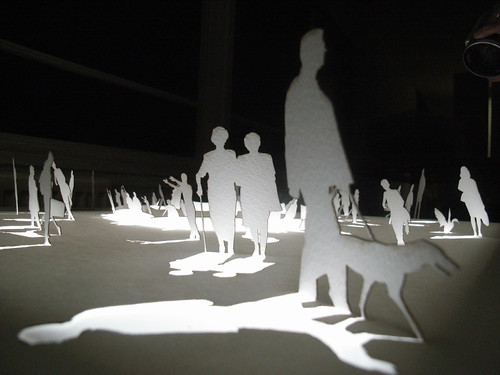
here are some pictures from the model (click on the picture for the ).

CPfNE fat project

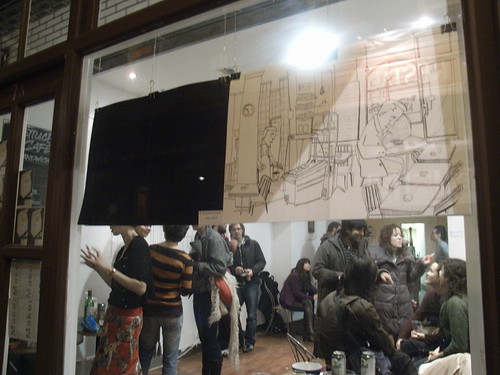
Alice Osborne, Michael Murdoch, maedelmaedel and i are co-organizing and showing work for the first of a hopefully ongoing art shindig here in london called MAKE, with this months’ theme being “minimum wage”. located in the (pronounced let-us-eat) sandwich cafe found near Liverpool Street tube station, strategically situated on the “” walking tour route.. ok, coincidentally found just off the sunday, 4 hour extended edition of the jack-the-ripper tour route, where tourists can use the wc, have a fag and tea and get handed a sandwich, all at the same time.

the opening will be this friday night at around 7pm with a performance by Lami Vo. here is the flyer with a smartly designed, built-in map for all of you that are gravitationally challenged:

Read More »

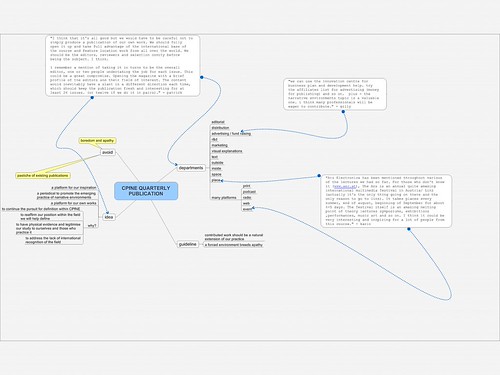
a few days ago in the bar i began toying with some peers, the idea of a CPfNE periodical publication. currently at “brain-fart” stage and far from being more then just a notion of drunken inspiration, i have thrown together a quick and dirty mind map to visualize the idea.

CPfNE QUARTERLY (3)

please take a look at the attached jpeg and let me know what you think; if it is a viable and worthwhile project, if you would actually contribute time and work towards such an endeavor and if it’s all wrong and how we should actually do it, if to do it at all.
all cut-ups welcome.

this week at school i am currently involved in a mandatory group project involving space intervention under the guise of social capital. the project involves several students from the MA courses of CSM school of design and school of interdisciplinary studies, including the Textile Futures MA students, Design Studies MA students, our colleagues at Industrial Design MA, MA Design by Project and of course, the MA Creative Practice for Narrative Environments posse. wuzzup.

so far it has been an intense 2 days of lectures, workshops, field work, research and meetings… lotsa, lotsa meetings. the project occurs in span of three days and in this time we are suppose to do all that and a bag o’ crisps… on top of getting to know each of our cross-discipline MA fellows, do an ethnographic study AND present an investiture of some sort. tomorrow is the crit. poo.

what we decided upon for a space2place intervention was to seek out and define the areas that were monitored by CCTV within london; something pretty easy to find, actually. the average londoner is photographed 300 times a day by CCTV cameras, not to mention some commercial spaces are even being audio recorded now so that conversations can be listened into in case of dissident smalltalk and flirting… i’ll let you chew on that for a moment.

using 2 inch wide yellow packing tape we marked out on the ground of covent garden, an area that was being monitored by CCTV. we choose covent garden specifically because it was at a crossways of several pedestrian walkways and roads, and was a meeting place and also a place for tourists and locals to work, shop and be at leisure. also using the same tape, we wrote out in plain english, signs on the ground denoting areas that were in and out of CCTV range.

our goal was to make apparent the actual boundaries and physical areas that were being monitored and vise versa. working differently then just a simple warning sign, people now had new perceptions of where and when their actions were being recorded.  along with the experiment, we also conducted surveys and a small anthropological activity to create a more rounded ethnological study. as the day progresses tomorrow, i will update this post with more materials and findings.

here is a photograph gallery of our field research day in covent garden.

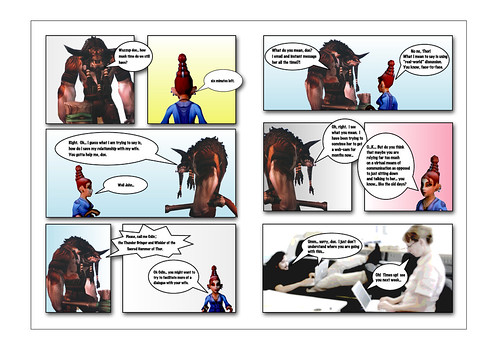
here is the World of Warcraft comic that was created by Myrto Karanika, Pernille Schmidt, Ryo Terui and yours truly.

WoW comic

this project is primarily for CSM – CPfNE (rationale in bold italics) so i suppose the following text will be quite boring to read (sorry!) unless you are involved with the course and for those of you reading this that are involved with the course, sorry it’s so boring!

We choose the comic format as our wayfinding proposal for Unit Two/Project Two for its tried and true historical role of being a media that is digestible, is dissident, and is also an accessible means to communicate socio-political ideas. it is also particularly favorable towards our target audience, which happens to be the “WoW addict”. it is also indirectly targeted towards the “counseling lifestyle professional” i.e., nutritionists, psychiatrists, etc.

the comic is entitled “Worldcraft”, to point out the wayfinding system that we are proposing within the context of the hybrid narrative. we propose that the counseling lifestyle professionals such as said examples play the game as in-game counselors. Other in-game players for advice regarding their own “real life” can then access these counselors. we feel that this would be a successful means to communicate advice, for it would still exist within the comforts of the virtual space that they have already been accustomed to.

click here for the large, readable version found on flickr. hope you enjoy it!

Design a site like this with WordPress.com
Get started