in the span of just a few days, 2 places that are close to me will never be the same.
after coming back from a friends’ birthday, karin, adam and i found ourselves standing outside camden station, just beyond the camden lock, watching blooms of smoke hit the sky. we had to make a lengthy detour to get home. looking at my phone when i reached my bed, i realized that i missed an sms from the neighbors. all it said was “camden is on fire!“.
Namdaemun gate in Seoul, South Corea is the oldest piece of history in the country. i have been working on a project with the city involving the ancient city walls, and the south gate once marked the entrance to the old city. recently opened to the public again, its burning marks a major blow to the historical commodity of the culture and nation. this also forces us who are working on the project to rethink the relevance of our proposals after such a tragic event.
no matter how far we have progressed, no matter how far technologically has advanced, no matter how morally enlightened we may become, fire always wins.
Once again proving the need for good, free parties in east London, kesselskramer stirred it up nicely this past friday night with nothing less then an old school house party at the opening event of KK OUTLET. What could be described as the “victorian cottage” to the agency’s deconsecrated church headquarters in Amsterdam (no seriously, it’s a church, which is why it’s not in parenthesis), KK OUTLET is store, gallery and office rolled into one. this three-prong smorgesboard of kung fu style provides new synergies between disciplines and practices, to offer unique solutions for unique briefs and clients.
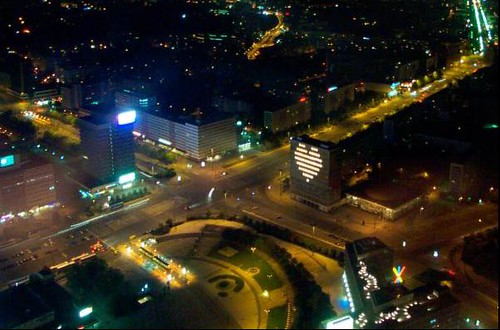
Seoul already pays much attention to lighting within the city, although projects seem to be lucid and playful now, a citywide plan or theme could provide continuity and strong identity. the first example of program for city lighting is alexanderplatz in berlin, where the ccc has been known to do their blinkenlights project:
next up is the SPOTS media facade in berlin, potsdamerplatz:
also on continental europe, rotterdam’s kpn building:
Green-Spaces
here’s a look at singapore. notice its concentration of green space in the heart of the city.
london’s green spaces are also mostly concentrated into key areas.
this differs compared to the cities of muenster and naarden, where green-space becomes a gesture of the former city wall within the urban planning.
this layout provides accessibility to green-spaces by a wider radius of city dwellers. If Seoul would adopt this continental european urban planning trend, It could provide for the city a common cross-section of park-space that links districts with automobile-alternative access. People could bike and walk from district to district within the park ring. An electric tram system or maglev train would be cool too…
Green-space within the city is freed from privileged neighborhoods and becomes accessible by all points of the city. for tourists and locals alike, it would activate the city wall as a monumental geographical feature for way-finding within the inner city.
it’s hard to draw lines. no, i don’t mean lines that make drawings. i am talking about the virtual lines and psycho-geographical boundaries we make for ourselves and the world around us. now that kairn and alex have joined me in rotterdam, our internship is in full swing. it seems like we have been working on this together for months already…
on order for us to digest the massively huge amount of data that AMO has produced over the years, we came up with a simple but effective way to quantify the ideas, concepts, themes and typologies. here is a short video that we produced during our first week of research. enjoy!
fitting that the final project for the first year of my MA degree involves working with fellow worshippers of the mightiest of all the of pantheon of gods, King Pendopoo. joining karin, alex and i on this final project is violeta and niki; video artist and scenographer, respectively.
the brief for this particular project involved generating sustainable and lasting dwell time within Granary Square, which happens to be the largest area of contingent public space in Kings Cross. this space is also important because it will link public, private, business and residential areas all together. i should probably also mention that Granary Square is situated directly in front of the site of the new Central Saint Martins College of Art and Design building which will finally bring all 4 campuses together under one roof.
The purpose of our proposal is to generate emotional durability within the social-geographic community known as Kings Cross Centre, focusing on the office worker and the cyber-slacking generation. Our proposal is a hybrid community building system consisting of three elements that are developed to engage members of the Kings Cross populace.
In order to generate sustainable desire to participate in the initiative, the proposal uses two easily accessible digital platforms that are facilitated with an essential third physical layer. The first digital platform is packaged in the form of a web-based, online community using Web 2.0 concepts. The second digital platform is packaged within the widely accessible platform of digital mobile phone technology to provide a personal, “always on”, portable interface device. we looked at accelerometer technology and other emerging technologies that would facilitate more intuitive game-play.
some other inspirational research included the Pacmanhattan geo-centric game:
Both digital platforms are used as interface to the physical “playground” of Kings Cross Centre for interaction with the various games and social networking systems. think Web 2.0 + Nintendo Wii + mobile phones using a physically real and unique space (Granary Square / Kings Cross Centre) as playing field; kinda like a giant Dance Dance Revolution game, er something…
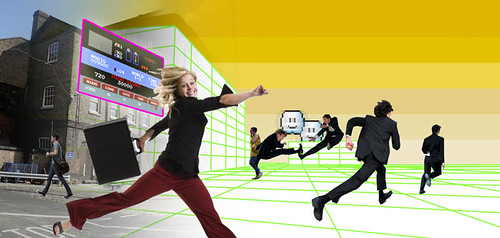
imagine office workers getting a little exercise in the morning before work by playing a short game in the square with their phone:
or spending their lunch break virtual fishing with their phones by the canal:
and then meeting in the evening to play dating games or larger, league tournaments:
in terms of learning outcomes, the great thing about this final project is that we were not limited by technology when it came to proposing our ideas. we worked together quite smoothly which was proof that karin, alex and i could collaborate together successfully.
i hope this is a sign for things to come when the three of us collaborate together again for our up-coming joint internship at the Office For Metropolitan Architecture this summer in rotterdam.
for another perspective from one of our tutors, please check out his blog entry about the project here.
it has taken me three months to reflect upon the recent quasi-disaster that was the abake prescribed, three part project, the zeitgeist heist.
since posting about the first two elements of the project, team dynamics have run-a-muck, and the last group dinner/brainstorming session ended up in a… shall we say, heated discussion, at best. after a particularly critical reaction from the panel during the second presentation, we did manage to meet one more time before the final crit, and came up with a poetic proposition to end such a seemingly futile attempt at designers trying to generate interactivity through performative means.
designers. actually we were a group which consisted of an architect, curator, exhibition designer and yours truly, media art monkee. without strong graphic design skills between the 4 of us, we luckily didn’t have to present a high in concept and research illustrated with flashy graphics presentation and presented as simply and to the point as possible, while adhering to some narrative themes (a guided tour comes to mind) to efficiently convey what we wanted to say.
rounding-up our colleagues and tutors into the stairwell on the 9th floor of our building, we made the group walk down the stairs holding a rope which formed a line. the stairwell is kinda groovy, with huge glass windows overlooking holborn. its cool and windy, walls littered with forgotten posters of past CSM shows and bad signage so you never know what floor you are on. hundreds of students walk up and down these stairs throughout a day.
people being people, we were soon a mix of bodies, while the four of us narrated a metaphorical and critical journey of our experience throughout this laborious project. we told emotional experiences, criticized the brief and its prescribers and more or less vented. we role-played as if we hated each other, which wasn’t far at the time (big kiss to aranzazu, gilly and anna)!
in the end, the tutors seemed positive about it and we had a chance to present something we were happy with, not to mention it made us stronger in the process. as the saying goes; you can only collaborate with people who want to collaborate. i have learned that my colleagues are damn good.
So as to follow up on the on-going antics of the gamelan gang, for the past few months the MACPNE department has been generating research and development that encompasses the design of a user experience and deployment of a pavilion to house the Indonesian instrument know as the gamelan. This commission is to coincide with the grand re-opening of the Royal Festival Hall and renewal of London’s Southbank Centre in mid-June of this year.
The gamelan is considered one instrument in Indonesian culture but when we got one delivered to our studio on the 9th floor of CSM’s Red Lion Square building a couple of months ago we discovered it was so much more then what we expected. as part of our research we were instructed in its playing by one of the UK’s premiere gamelan players and gamelan expert in residence at Southbank Centre, Sophie Clark.
A lil’ diddy about the gamelan; a complex collection of percussion instruments, the version of the gamelan we played (there are several different types of gamelans from the various island districts that Indonesia is comprised of) is considered the “portable” version. the full-size version of the gamelan maintained by southbank centre is housed in its own room within the Royal Festival Hall.
Gamelan music is composed of intricate patterns that are unique to the each part of the gamelan and is quite mathematical; Bach would have had a handful to deal with. Every gamelan is tuned within itself, so every gamelan sounds different from one another. Playing a composition on one set could sound drastically different on another, and often players learn all instruments and rotate so that everyone plays each part of the gamelan throughout a performance.
The gamelan is the centerpiece of local Indonesian community. most Indonesian people that live around a pendopo (a building that serves as something reminiscent to a town hall or community centre) learn how to play or at least have heard a gamelan before at one point or another. It is an important element in shadow puppet theater (called wayang) and as accompaniment to Indonesian dance and ceremony. It is used for old-school jammin’, too.
Within the pendopo, the gamelan is played at ground level where musicians sit alongside spectators on even ground. Gamelan sessions have the potential to last days, and often people come to the pendopo and eat with family and friends, converse with fellow community members and even take naps in the shade away from the heat. Everyone in the pendopo is barefoot, which adds to the general coziness of the atmosphere.
right… so back to the project, other research conducted included people flow studies, ethnographic research interviews with gamelan groups, visitors to Southbank Centre and local skateboarders at the skate park adjacent to the Royal Festival Hall, reading of the ancient texts the Ramayana and Mahābhārata and site visits to the rebuild / retrofitting of the Royal Festival Hall.
After a consultation with structural engineers, the final pitch will occur this Friday, a day after another crit for a project for the master-planning of the new Kings Cross Center in London.
I think it’s going to be yet another tough and exciting week.
In 1982 Larry Dossey, an American physician, coined the term “time-sickness” to describe the obsessive belief that “time is getting away, that there isn’t enough of it, and that you must pedal faster and faster to keep up”.
Guy Claxton, a British psychologist, thinks acceleration is now second nature to us: “We have developed an inner psychology of speed, of saving time and maximising efficiency, which is getting stronger by the day”.
These comments and quotes motivated our group to base our final Unit 1 project on the new trend of ‘slow’ living; to ask ourselves whether conducting one’s day to day actions slowly genuinely promotes quality of life, and whether this quality can generate happiness and wellbeing.
Festina lente is the best way to describe the essence of all the movements which proclaim the need for people to slow down (Slow City, Slow Food, Slow Sex, Super Slow Exercise, Slow Dating, etc.). It is a phrase attributed to Svetonius and was often used by Caesar Augustus, and means to quicken slowly. The saying encapsulates numerous dichotomies, such as patience and urgency, velocity and flexibility, action and meditation. In the case of movements such as Slow Living, it refers specifically to a lifestyle which “respects tradition and quality, and seeks to use the best aspects of the modern world to enhance, preserve and enjoy the old ways of doing things, but not to the exclusion of progress and not for the sake of avoiding change”.
Our group’s idea was to create a video which would illustrate vividly this contrast which is now common in society between people who choose to slow down and people who continue fast-paced living, as well as seeing how people would react to our ‘slow’ intervention and seeing if it is true that British people are ever increasingly looking for ways to calm down modern life rhythms.
Our intervention comprised of an afternoon tea break taken along the river Thames at Southbank. Our group set up a table and held a proper and original afternoon tea party with a china set, scones and preserves, in order to raise awareness among those walking by so that they too should sit and take a break.
The choice of having a tea break as our intervention fell upon our desire to use something which is very close to the British people, so as to not only research into slow and fast perceptions of time but also on identity and traditions. As we researched into the history of tea, it became obvious to us that tea is extremely important to all cultures, from the Russian zavarka using tea to welcome guests into one’s home to the Moroccan mint tea served to cool down on hot days and facilitate social community.
Tea is the most consumed beverage in the world after water. It has taken on many forms and has much significance throughout history. It is a symbol of relaxation and generates social interaction.
BACKGROUND RESEARCH – TEA IN THE BRITISH CULTURE
AFTERNOON TEA or LOW TEA: A traditional afternoon tea is served between 3 PM and 5 PM at a low table. The menu consists of three courses-assorted crustless finger sandwiches and savouries, scones with Devonshire (clotted) cream and preserves and assorted finger sweets and petit fours. It is not uncommon for a trifle or dessert to add as a fourth course.
INFORMAL AFTERNOON TEA: Served in a salon or outdoor setting, with either placement seating or casual seating at low tables. Candles are never used.
(http://www.seedsofknowledge.com/teahistory.html)
Great Britain was the last of the great sea-faring nations to break into the Chinese and East Indian trade routes. The first samples of tea reached England between 1652 and 1654, and it quickly proved popular enough to replace ale as the national drink. Prior to the introduction of tea into Britain, the English had two main meals – breakfast and dinner: Breakfast was usually composed of ale, bread and beef, while dinner was a long, massive meal at the end of the day. It was without a doubt an impractical way of distributing food throughout the day and many often felt sluggish by mid-afternoon. It is said that it was the 7th Duchess of Bedford, Anna, who introduced the concept of afternoon tea, which included other than tea also small cakes and bread and butter. The novelty soon took on and it became almost immediately a very popular activity of the day. It was Queen Victoria who introduced the custom of adding lemon to tea, after visiting one of her daughters in Russia – before that, the English took only milk with their tea.
A common pattern of service soon merged. The first pot of tea was made in the kitchen and carried to the lady of the house who waited with her invited guests, surrounded by fine porcelain from China. The first pot was warmed by the hostess from a second pot (usually silver) that was kept heated over a small flame. Food and tea was then passed among the guests, the main purpose of the visiting being conversation.
Tea was introduced into the British culture as a time to meet friends, to relax and to regenerate.
RESULTS AND OBSERVATIONS
Our performance not only attracted many passers-by but also generated in us mixed feelings – though we felt that our actions were forcibly too slow, we felt as if we were practicing yoga: our breathing calmed down, our heart rate appeared to beat slower. Those who stopped to watch us were informed of our project and ask to contribute comments which we audio recorded. It is interesting to note that most people were pleased to watch us and almost observed us with envy, and when asked about what they thought with regards to ‘slow’ living, most responded that it was an unobtainable dream, that though they too wanted to slow down they felt that it was not possible. Few people said that they have recently made changes to their lifestyles, so as to include more quiet time or thinking time, by themselves or with their companions, but all stated that they were not yet satisfied with their quality of life. Most of those who responded positively to our questions were nevertheless in their mid-40s and they tended to stress the fact that their decision to change their lifestyles derived from years of fast-paced living.
Lucky for me I am on break now and have some time to prepare for the next term. Part of the requirement of the 1st year of my MA is to participate in a professional internship.
For the first time in the history of the course, Karin, Alex and I are applying as an R&D team collectively for our internship. Our course director refers to us as “the 3 for 2 deal”, we hope to continue our collaborative strategizing and development that has been fostered at the course and contribute to a creative organization we could be happy to work for.
One of our dream companies that we have collectively approached is the Office of Metropolitan Architecture, also know as OMA and their alter-ego, AMO.
We have prepared a portfolio for them based on our past work, and details on a new collaborative work we specifically developed for the OMA application. We have bound and printed 5 copies of the book so far but if you would like a copy, let me know and we can work something out ;^)
A little more about OMA: OMA is the architecture firm of Rem Koolhaas and was founded in 1975 along with Elia Zenghelis, Madelon Vriesendorp and Zoe Zenghelis. They are the architecture firm responsible for some of the coolest buildings and interiors, and have published books as their brainy thinktank alter ego, AMO.
In order for us to meet the deadline of application, Karin, Alex and I had to produce and publish a book in less then 5 days. In the end we had it bound before jumping onto a plane to do a re-branding project in Benidom, Spain. The final assembly of the package was done on a sunny beach on the Mediterranean. Our cover letter was written on a postcard addressed to our Oma, which happens to be German and Dutch for grandmother. There were a lot of grandmas out and about in Benidorm, BTW. Now cross your fingers. Thanks!







 villainous.biz
You must be logged in to post a comment.