for the past couple weeks the team and i have been working hard getting our multitouch video/installation/performance interface to an alpha state, and meet our march 12th deadline. this has definitely been the most difficult personal project i have worked on, as i feel much of the development depends of the diverse skills, knowledge and background of my teammates. some of the hardest decisions to make are simply to trust in the opinions, skills and knowledge that my teammates bring to the project. no longer something i can consider mine, the project has become a great example of the co-creative process. we are not working with the market in mind, but to simply get a chance to work together with good people and have fun doing something we are all interested in.
the project is defined by three key elements. these elements are the hardware design, the software design, and the usability and performative aspects. each element is highly reliant on the other, and i really have no idea how i would have gotten this far if it wasn’t for the excellent, dedicated and incredible people i am collaborating with.
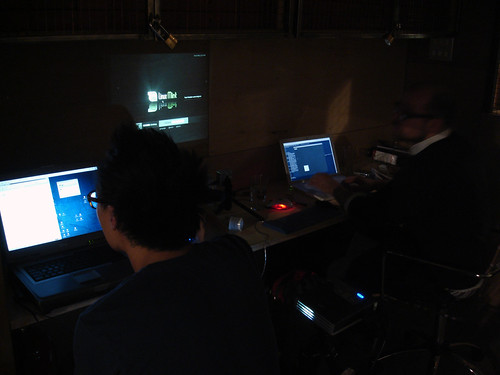
in terms of software and usability, Jan and Martin; our dynamic duo of software developers, spent the weekend setting up the essential underpinnings and infrastructure of the Stutterbox interface. working with our user Crystal; who is a talented designer, video performance artist and fellow MACPNE colleague, we continued to iron out the metaphors we will use for the interface and address the critiques and suggestions raised during the course of its development and production.
at the moment we are trying to blend the VJ workspace with the actual performance output display. by making a hybrid interface between workspace and output, Crystal will be able to construct her performance narratives in the same area where the story would unfold for the audience. this somehow reminds me of the process of making graffiti, as in graffiti the inspiration, workspace and gallery end up being the same place. as graffiti artists make the urban environment all three places at once, so should our multitouch interface.
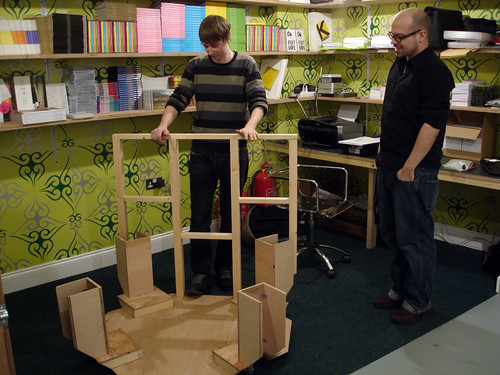
regarding hardware, Adam and i are now at the stage of putting everything together we made in the woodshop last week. Adam is my oldest friend (we’ve been friends for something like 15 years!) who came over from toronto via berlin to help me out. he happens to be a talented industrial designer and it shows in the craftmanship of the design and construction of the table. it really is well (if not over!) built.
in order for us the have full, 24h access to the table, we have moved much of the hardware to KKOUTLET so we can continue building without the encumbrance of closing times and security guards, which we were running into working at CSM. at the moment we are around 75 percent done with the construction, and hope to begin to drop in the electronics by wednesday.
curious of the ever farcical “democratic” process that festers in the united states, i payed a visit to www.californiaprogressreport.com, which has a copy of the debate transcript between hillary clinton and barack obama in los angeles on the 31st of january, earlier this year.
other then it being an utterly boring and mind-numbingly mundane back-and-forth of the usual lies and malarky so akin to people of their stature (read: politicians), i was curious about the vocabulary they used. reducing the debate to weighted lists, patterns such as favorite words, key issues, etc. can be derived and speculated on. take a look for yourself and come to your own conclusions of deceit and conspiracy. i for one will not be voting for either of them, namely because i am not a US citizen and have been cursed with the nationality of being Canadian, where nation wide healthcare is forced upon its population so widely and ruthlessly that you may have heard about it in popular culture.
its been about a month now and i have finally digested my recent trip to Korea (and have also finally digested that last korean meal). what can i say about my experiences in seoul? in all honesty i was very much overwhelmed with the entire journey, and probably took so long to write this because i didn’t know where to begin. now that i think about it, i would say it’s about hopeless for me to encapsulate the time i had there, so i will just post an email i sent to an old friend:
i have to say that seoul and korean peeps and korean culture has really blown me away. i was only in seoul for a week, but had the most amazing, most memorable time. other then the usual starstruck wanderings, i really feel that seoul is a place in mid blossom. we went down for a project regarding re-branding the city and are contracted to help it along part of its 15 year plan to change it into a knowledge economy. my minuscule bit of a tiny part of a small section of a grand scheme involves designing experiences for tourists that include the old seoul city walls and gates.
i see many parallels between korea and germany before reunification and this is most apparent in the people. there is something so inherently strong about being korean, but the split has offered two very diverging paths between one peoples, i think i saw some korean cinema on the plane about it. paired with such a sudden and rapid growth in south korea, the culture has been so engineered and is in need of conceptual thinking within its design process. an empty space breeds room for innovation and creativity, and i believe seoul has the void, resources and potential to engineer its own renaissance.
seoul is built on the scale akin to berlin but bigger, just waiting for people to come live the city. sure there is traffic like any city, but there is a feeling of space when you’re on the pedestrian level. seoul’s highest and lowest geographical points offer so much.
one day the grad students from IDAS took us up to the top of one of the many mountains that surround seoul, in a DMZ where the north gate and blue house resided. we were told some funny story about the women who would come out here in full moon to bask in the light for fertility and the men that would stand around the gate singing songs trying to court them (i wouldn’t know where to begin nor would be competent to even talk about korean gender politics).
and the food! korean food is my super-fav now! every night we ate like japanese businessmen, from bbq to traditional dinners, drinking soju and bamboo wine like water (and some milky, slightly fizzy from the fermentation, cool rice wine), going to karaoke and hiphop/r&b clubs and window shopping at 4 am in the morning at dongdaemun sitting in little tent cities of street vender’s, eating dumplings. on the last night we sat in our studio and ate cake and smoked mackerel using chopsticks and sipped on egg broth while downing soju till the morning to catch a plane. one of my colleagues lost his passport while on his way to the airport (so he says ;-P) and had to stay a few more days by himself; our contact at the school brought him out to a sauna as absolution (lucky devil).
for some images of Seoul take a look at my flickr album here.
it’s hard to draw lines. no, i don’t mean lines that make drawings. i am talking about the virtual lines and psycho-geographical boundaries we make for ourselves and the world around us. now that kairn and alex have joined me in rotterdam, our internship is in full swing. it seems like we have been working on this together for months already…
on order for us to digest the massively huge amount of data that AMO has produced over the years, we came up with a simple but effective way to quantify the ideas, concepts, themes and typologies. here is a short video that we produced during our first week of research. enjoy!
the time goes by so quickly. it’s blinding, the speed of it all. i will attempt to summarize my experiences so far this season.
how do i quantify the value of this last month? so soon the pang of summer will be upon us. as is in most states of change, this spring has been a torrential series of mountains and valleys; no doubt that king pendopoo himself need prove to one and all our (in)significance, as we walk the precarious landscape of the long now.
of all the events that can change the course of life in any given direction, some stand out as president, its true significance only apparent to some. the first was known to me back in march. karin, alex and i received news from OMA in rotterdam that we were to join them for the summer as an intern “dream team” for the thinktank section of the company called AMO. since that time, i have been steadily gearing myself towards our eventual move to rotterdam to participate in arguably, one of the most exciting firms in architecture/urban planing today.
meanwhile, with the new spark that collaborative strategies offered, karin, alex and i did some great work with violeta houbenova and niki lampaski for the Argent/kings cross regeneration in the city of london. while working on this project, i soon re-realized the importance of the virtual domain and its blurring of perception and paradigm. as the real and virtual became unified, so do our online experiences collide with real life making our lifestyle that much more intangible, the two complimenting one another more and more by the nanosecond. this project was so well received that the director of my MA course in london has decided that the project is worth pursuing farther. this good news of course, excited me. along with our joint internship with OMAMO, i felt as if everything i have learned up to this point was being harnessed and directed towards a bright future.
then my grandma in singapore passed away. it wasn’t unexpected, as she was sick already for quite some time, yet it is truly miraculous what she has achieved in her lifetime, with the cultivation of such an amazing and loving family that spans the globe. as matriarch of our widespread clan, she was our living ancestor from a time when life was very different and proved to us the invaluable skill of adaptation. my relationship with her was sparse but never temporal – i would say timeless. i will miss her very much but know that her legacy will persevere in the people she has affected in her lifetime.
and not only did i loose my grandma this month but i lost my OMA as well. just last week karin, alex and i received a letter from OMA stating that they could not find an appropriate project for us (but we suspect it was actually for visa reasons). this unfortunate turn of events completely disrupted my plans for the summer, already giving notice to our landlord that we would leave our flat in london, not to mention losing the dream of working for a company that so inspires such as OMA. my collegue Myrto put it quite bluntly to me; as a young architect, from OMA, there is no where else to go but down.
not knowing what to do next, i reached out to my friend and mentor Dan Hill, of cityofsound.com and monocle magazine fame. he was the first person i turned to and his help and advice has been spot on and extremely supportive. seeing more in me then i have wisdom to even notice, he has taught me the genius of personal experience. after talking to him i pulled myself together and began to rearrange my outlook of the future. he also kindly posted on his enlightening weblog about karin, alex and me, even in the midst of organizing Postopolis! in NYC. because of his invaluable input and the inspiration of just witnessing his own practice, i realized the immense work and passion that one has to endure to be happy with what they do.
this morning i set out to find a new place to live since i am about to be homeless on the 6th of june. when walking out of the finsbury park tube station, i noticed that alex was trying to call me so i took a seat on the curb and gave him a call. he frantically conveyed to me that OMA wrote back and said they wanted us, after all. then i asked myself, how can this month get anymore thrilling?
i asked what the bleep is it too when i first saw one. QR code is what’s known as a two dimensional barcode, or matrix code dreamed up by Denso-Wave of Japan in 1994. they are used in Japan quite a bit, but you can also find QR code online. i first saw the code on cityofsound.com and became curious, so i did some research.
QR code can be read by most modern camera phones. you can grab the software from here, and start generating codes here. what’s fun is that you can load it up with all sorts of info and also has some pretty dope applications.
for instance, you can have a phone directly sms any number upon acquiring a positive scan. you can load rss feed addresses so that you can aggregate information such as flickr photostreams, gmail and podcasts. you can also use it to leave simple text messages or numbers. the more info within the code, the more complex and dense the pattern becomes.
being a relatively old system, i am sure that people have been using it in graffiti and urban art. it is most definitely being used in the advertising sector and there are even design firms that specialize in integrating QR code into communicative design.
karin and i were toying the other day about using QR Code as blueprints for urban planing. imagine scanning QR code in google earth of entire city blocks and getting links to concise information directly to your mobile phone. well.. just a thought. if it has already been implemented then please post a link.
i have incorporated QR code into my weblog on the sidebar. with a flick o’ the wrist, you can have my contact details automagically upload directly into your phone. pretty sweet at the bar, if it was tattooed somewhere accessible.
In 1982 Larry Dossey, an American physician, coined the term “time-sickness” to describe the obsessive belief that “time is getting away, that there isn’t enough of it, and that you must pedal faster and faster to keep up”.
Guy Claxton, a British psychologist, thinks acceleration is now second nature to us: “We have developed an inner psychology of speed, of saving time and maximising efficiency, which is getting stronger by the day”.
These comments and quotes motivated our group to base our final Unit 1 project on the new trend of ‘slow’ living; to ask ourselves whether conducting one’s day to day actions slowly genuinely promotes quality of life, and whether this quality can generate happiness and wellbeing.
Festina lente is the best way to describe the essence of all the movements which proclaim the need for people to slow down (Slow City, Slow Food, Slow Sex, Super Slow Exercise, Slow Dating, etc.). It is a phrase attributed to Svetonius and was often used by Caesar Augustus, and means to quicken slowly. The saying encapsulates numerous dichotomies, such as patience and urgency, velocity and flexibility, action and meditation. In the case of movements such as Slow Living, it refers specifically to a lifestyle which “respects tradition and quality, and seeks to use the best aspects of the modern world to enhance, preserve and enjoy the old ways of doing things, but not to the exclusion of progress and not for the sake of avoiding change”.
Our group’s idea was to create a video which would illustrate vividly this contrast which is now common in society between people who choose to slow down and people who continue fast-paced living, as well as seeing how people would react to our ‘slow’ intervention and seeing if it is true that British people are ever increasingly looking for ways to calm down modern life rhythms.
Our intervention comprised of an afternoon tea break taken along the river Thames at Southbank. Our group set up a table and held a proper and original afternoon tea party with a china set, scones and preserves, in order to raise awareness among those walking by so that they too should sit and take a break.
The choice of having a tea break as our intervention fell upon our desire to use something which is very close to the British people, so as to not only research into slow and fast perceptions of time but also on identity and traditions. As we researched into the history of tea, it became obvious to us that tea is extremely important to all cultures, from the Russian zavarka using tea to welcome guests into one’s home to the Moroccan mint tea served to cool down on hot days and facilitate social community.
Tea is the most consumed beverage in the world after water. It has taken on many forms and has much significance throughout history. It is a symbol of relaxation and generates social interaction.
BACKGROUND RESEARCH – TEA IN THE BRITISH CULTURE
AFTERNOON TEA or LOW TEA: A traditional afternoon tea is served between 3 PM and 5 PM at a low table. The menu consists of three courses-assorted crustless finger sandwiches and savouries, scones with Devonshire (clotted) cream and preserves and assorted finger sweets and petit fours. It is not uncommon for a trifle or dessert to add as a fourth course.
INFORMAL AFTERNOON TEA: Served in a salon or outdoor setting, with either placement seating or casual seating at low tables. Candles are never used.
(http://www.seedsofknowledge.com/teahistory.html)
Great Britain was the last of the great sea-faring nations to break into the Chinese and East Indian trade routes. The first samples of tea reached England between 1652 and 1654, and it quickly proved popular enough to replace ale as the national drink. Prior to the introduction of tea into Britain, the English had two main meals – breakfast and dinner: Breakfast was usually composed of ale, bread and beef, while dinner was a long, massive meal at the end of the day. It was without a doubt an impractical way of distributing food throughout the day and many often felt sluggish by mid-afternoon. It is said that it was the 7th Duchess of Bedford, Anna, who introduced the concept of afternoon tea, which included other than tea also small cakes and bread and butter. The novelty soon took on and it became almost immediately a very popular activity of the day. It was Queen Victoria who introduced the custom of adding lemon to tea, after visiting one of her daughters in Russia – before that, the English took only milk with their tea.
A common pattern of service soon merged. The first pot of tea was made in the kitchen and carried to the lady of the house who waited with her invited guests, surrounded by fine porcelain from China. The first pot was warmed by the hostess from a second pot (usually silver) that was kept heated over a small flame. Food and tea was then passed among the guests, the main purpose of the visiting being conversation.
Tea was introduced into the British culture as a time to meet friends, to relax and to regenerate.
RESULTS AND OBSERVATIONS
Our performance not only attracted many passers-by but also generated in us mixed feelings – though we felt that our actions were forcibly too slow, we felt as if we were practicing yoga: our breathing calmed down, our heart rate appeared to beat slower. Those who stopped to watch us were informed of our project and ask to contribute comments which we audio recorded. It is interesting to note that most people were pleased to watch us and almost observed us with envy, and when asked about what they thought with regards to ‘slow’ living, most responded that it was an unobtainable dream, that though they too wanted to slow down they felt that it was not possible. Few people said that they have recently made changes to their lifestyles, so as to include more quiet time or thinking time, by themselves or with their companions, but all stated that they were not yet satisfied with their quality of life. Most of those who responded positively to our questions were nevertheless in their mid-40s and they tended to stress the fact that their decision to change their lifestyles derived from years of fast-paced living.
Another week, another project, another learning log entry.
our guest tutors for the Zeitgiest Heist are Adam Levene, Benjamin Reichen and Man Somerlink. also joining are the usual suspects, Tricia Austin, Kevin Flude and Sarah Featherstone.
the initial research conducted for this project included the selection of a location, place or space where an object was stolen, lost or missing and then to document that non-space or void space as a photograph. here is the location i chose:
In a workshop, all the students exposed there photographic work alongside three dimensional work which we had to make in one hour from foraged materials and found objects (read: garbage). tutors then tried to place the newly made object within the non-space depicted by the photograph.
using whatever we learned from this experimental exercise, we then preceded to part two of the brief, which involved using the “missing” approach or methodology to choose a building or public space based on the lack or deficiency of a story.
most of a buildings’ interior and exterior architecture is constructed to communicate definite themes. a police station for instance communicates to the visitor connotations that may include power, intimidation, functionality, confinement, etc.
after considering the identity/message/story of a handful of buildings and locations in London, my group choose the Greenwich Observatory where the Prime Meridian was established. this was an obvious choice for its socio-cultural associations and political symbolism. The very fact that the modern understanding of time is defined with the Prime Meridian as measure lead us to risk a reinterpretation of the brief in order to argue the Meridian as an architectural, imperialistic construct.
using the philosophies of the Long Now Foundation, we designed an intervention that included a campaign to enrich visitors of the observatory. mostly we wanted to see how people envisioned the future.
in the 21st century, most people envision it as a distopia ridden with disease, poverty and nuclear fallout barely held together by an ultra-police-state. this future is usually placed within the the confines of ones own lifetime and not beyond generations. imagine the implications and the goals that we collectively strive towards from this shortsightedness!
in order to free the minds of our audience from the heavy handed oppression of time in its current definition, our heist was to steal time itself. this proved to be far too difficult a campaign for only the four of us to achieve in one morning. oh well.
with the winter break on the cusp of conclusion (i hope everyone had a good and safe holiday this year), i managed to mozy on down to the internet today to check my mail, get some slash and do that internet do. so with a laid-back saunter, here begins another year of amateurish participatory dabbling into this web2.n0 sh!zznat.
that sweet spot between xmas and new years (also known as the busiest time in the box office film industry) plays host to the chaos communication congress brought to us by the chaos computer club, where many of those same box office hits were being torrented, i might add or so i hear. This year was the 23rd annual itineration of the event and was also the most visited one in the history of the congress with +4200 visitors.
There were geeks and nerds everywhere and i was one with the hurd, club mate in hand. people where fully maximizing the volume of the space. i even got a chance to sleep in saal 1 on 2 chairs (i hear that animation students have a special affinity to the sleeping in 2 chairs style) just to get a hard line into the switch, only to wake up with people on mass sprouting from all around me to set up temporary hack-stations as lectures reconvened.
This year i was fortunate enough to participate as a herald for the congress, which basically meant i had an opportunity to steal a few words from the guest speakers, if only for the sake of introducing those in a proper and un-fugly like fashion to hundreds of people.
There were some good people present and i had a chance to see some friends sorely missed. Martind of desktop.de fame was organizing the heralds for the congress this year and showed me the ropes of being a herald. My old collaborator and comrade b1nary.k0a1a was there too, and got to meet some new and interesting folks.
The most interesting talk of note this year for me was Lawrence Lessig’s presentation – On Free, and the Differences between Culture and Code. It was the first time i had seen him live. He apparently has a distinct style of presentation. All i have to say is that he is definitely a powerpoint/keynote expert. Check out the google video stream below and judge for yourself at 400×326 pixels-per-inch of glorious resolution:
For my second time around i have to say that i love this congress more and more. I look forward to next year and will remember to again, bring more hard drives!
every year the chaos computer club holds the chaos communication congress in Berlin, Germany. this is a great time for hackers of all disciplines to finally come together in an actual, physically shared space (as opposed to a virtual one, although i have seen some second lifers about) to discuss, teach and learn from one another within the community.




 villainous.biz
You must be logged in to post a comment.