Skip navigation

Category Archives: exhibition design

for the past couple weeks the team and i have been working hard getting our multitouch video/installation/performance interface to an alpha state, and meet our march 12th deadline. this has definitely been the most difficult personal project i have worked on, as i feel much of the development depends of the diverse skills, knowledge and background of my teammates. some of the hardest decisions to make are simply to trust in the opinions, skills and knowledge that my teammates bring to the project. no longer something i can consider mine, the project has become a great example of the co-creative process. we are not working with the market in mind, but to simply get a chance to work together with good people and have fun doing something we are all interested in.

the project is defined by three key elements. these elements are the hardware design, the software design, and the usability and performative aspects. each element is highly reliant on the other, and i really have no idea how i would have gotten this far if it wasn’t for the excellent, dedicated and incredible people i am collaborating with.
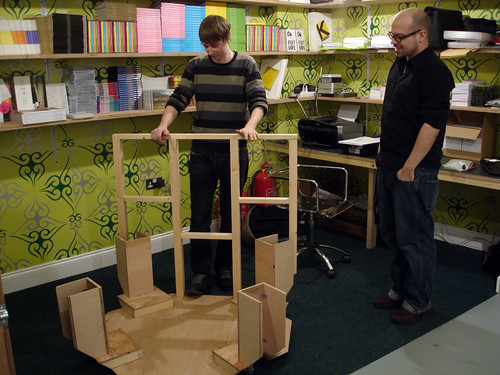
in terms of software and usability, Jan and Martin; our dynamic duo of software developers, spent the weekend setting up the essential underpinnings and infrastructure of the Stutterbox interface. working with our user Crystal; who is a talented designer, video performance artist and fellow MACPNE colleague, we continued to iron out the metaphors we will use for the interface and address the critiques and suggestions raised during the course of its development and production.
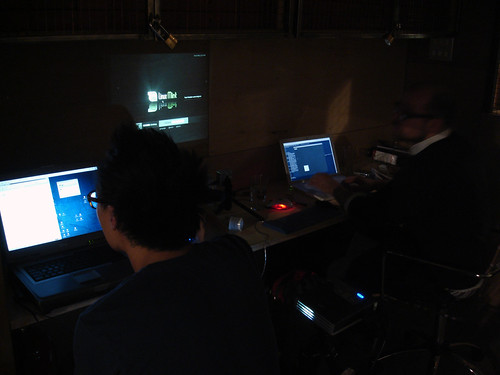
at the moment we are trying to blend the VJ workspace with the actual performance output display. by making a hybrid interface between workspace and output, Crystal will be able to construct her performance narratives in the same area where the story would unfold for the audience. this somehow reminds me of the process of making graffiti, as in graffiti the inspiration, workspace and gallery end up being the same place. as graffiti artists make the urban environment all three places at once, so should our multitouch interface.

martin dittus

regarding hardware, Adam and i are now at the stage of putting everything together we made in the woodshop last week. Adam is my oldest friend (we’ve been friends for something like 15 years!) who came over from toronto via berlin to help me out. he happens to be a talented industrial designer and it shows in the craftmanship of the design and construction of the table. it really is well (if not over!) built.

in order for us the have full, 24h access to the table, we have moved much of the hardware to KKOUTLET so we can continue building without the encumbrance of closing times and security guards, which we were running into working at CSM. at the moment we are around 75 percent done with the construction, and hope to begin to drop in the electronics by wednesday.

Created with Admarket’s flickrSLiDR.

Lighting

Seoul already pays much attention to lighting within the city, although projects seem to be lucid and playful now, a citywide plan or theme could provide continuity and strong identity. the first example of program for city lighting is alexanderplatz in berlin, where the ccc has been known to do their blinkenlights project:

ccc2

ccc1

next up is the SPOTS media facade in berlin, potsdamerplatz:

also on continental europe, rotterdam’s kpn building:

Green-Spaces

here’s a look at singapore. notice its concentration of green space in the heart of the city.

singapore

london’s green spaces are also mostly concentrated into key areas.

london

this differs compared to the cities of muenster and naarden, where green-space becomes a gesture of the former city wall within the urban planning.

muenster

narden

this layout provides accessibility to green-spaces by a wider radius of city dwellers. If Seoul would adopt this continental european urban planning trend, It could provide for the city a common cross-section of park-space that links districts with automobile-alternative access. People could bike and walk from district to district within the park ring. An electric tram system or maglev train would be cool too…

seoul

Green-space within the city is freed from privileged neighborhoods and becomes accessible by all points of the city. for tourists and locals alike, it would activate the city wall as a monumental geographical feature for way-finding within the inner city.

its been about a month now and i have finally digested my recent trip to Korea (and have also finally digested that last korean meal). what can i say about my experiences in seoul? in all honesty i was very much overwhelmed with the entire journey, and probably took so long to write this because i didn’t know where to begin. now that i think about it, i would say it’s about hopeless for me to encapsulate the time i had there, so i will just post an email i sent to an old friend:

i have to say that seoul and korean peeps and korean culture has really blown me away. i was only in seoul for a week, but had the most amazing, most memorable time. other then the usual starstruck wanderings, i really feel that seoul is a place in mid blossom. we went down for a project regarding re-branding the city and are contracted to help it along part of its 15 year plan to change it into a knowledge economy. my minuscule bit of a tiny part of a small section of a grand scheme involves designing experiences for tourists that include the old seoul city walls and gates.

Seoul Tilt | Shift 2

i see many parallels between korea and germany before reunification and this is most apparent in the people. there is something so inherently strong about being korean, but the split has offered two very diverging paths between one peoples, i think i saw some korean cinema on the plane about it. paired with such a sudden and rapid growth in south korea, the culture has been so engineered and is in need of conceptual thinking within its design process. an empty space breeds room for innovation and creativity, and i believe seoul has the void, resources and potential to engineer its own renaissance.

seoul is built on the scale akin to berlin but bigger, just waiting for people to come live the city. sure there is traffic like any city, but there is a feeling of space when you’re on the pedestrian level. seoul’s highest and lowest geographical points offer so much.

Seoul Tilt | Shift 1

one day the grad students from IDAS took us up to the top of one of the many mountains that surround seoul, in a DMZ where the north gate and blue house resided. we were told some funny story about the women who would come out here in full moon to bask in the light for fertility and the men that would stand around the gate singing songs trying to court them (i wouldn’t know where to begin nor would be competent to even talk about korean gender politics).

and the food! korean food is my super-fav now! every night we ate like japanese businessmen, from bbq to traditional dinners, drinking soju and bamboo wine like water (and some milky, slightly fizzy from the fermentation, cool rice wine), going to karaoke and hiphop/r&b clubs and window shopping at 4 am in the morning at dongdaemun sitting in little tent cities of street vender’s, eating dumplings. on the last night we sat in our studio and ate cake and smoked mackerel using chopsticks and sipped on egg broth while downing soju till the morning to catch a plane. one of my colleagues lost his passport while on his way to the airport (so he says ;-P) and had to stay a few more days by himself; our contact at the school brought him out to a sauna as absolution (lucky devil).

for some images of Seoul take a look at my flickr album here.

Created with Admarket’s flickrSLiDR.
monday marked a milestone of good intentions, as 2nd year students from the 2008 graduating (pending) class of my MA degree hosted schematic proposals for our final project. i was lucky enough to grab a good spot to present (last before the first brake) but was still stoopid nervous at trying to pitch my project in front of both years of the program, the program director, the guest critique tutor and our 4 project tutors.

the projects were pretty interesting, and it’s good to see that most of the projects are developing quite nicely. people seem to have solidified their concepts and there appears to be an end in sight!

some of the projects included a psycho-geographical atlas, a ceramic tile that gets worn away with the passage of people to reveal evolving content, the future of outdoor media, emergency shelters that are customizable to the typology of refugee, an allegorically immersive museum installation of baroque carriages for the pope, a user-design led participatory show, an engaging workshop that reaches out to the muslim communities in london, an urban installation that addresses the feeling of danger and security in hackney, a workshop that gets artists and architects to understand how to collaborate, an edible garden, and many, many other insightful projects.

and my project? i will hopefully get to work with some inspiring people to develop a grassroots oriented, multitouch interface. if you are interested, here is the link to a pdf of my presentation.

it’s hard to draw lines. no, i don’t mean lines that make drawings. i am talking about the virtual lines and psycho-geographical boundaries we make for ourselves and the world around us. now that kairn and alex have joined me in rotterdam, our internship is in full swing. it seems like we have been working on this together for months already…

on order for us to digest the massively huge amount of data that AMO has produced over the years, we came up with a simple but effective way to quantify the ideas, concepts, themes and typologies. here is a short video that we produced during our first week of research. enjoy!

Design a site like this with WordPress.com
Get started