Hello World!
reeling from an amazing trip to rotterdam for bruno and the hackers wedding.
last wednesday marked a milestone in my pursuit of a graduate degree in creative practice for narrative environments at central saint martins. the entire graduating class was required to hand in and defend their final project. it was a challenging final presentation as the external examiner, all tutors and the entire class were there to bare witness.
what was most interesting to me was the paths of development undertaken by each student and their works. it amazes me how much an idea can change dramatically through the process of production, my project being no different. what started out as research into the phenomenon of boredom and purposeless play has turned into a collaborative project developing a realtime, visual storytelling tool for the video, installation and performance artist.
my project. those words no longer are relevant to the project i presented that day. almost a passing thought for the uses for multitouch technology outside the exhibition and museum world, StutterBox has become a project so far removed from the original idea that authorship should be dually credited to the following people:
Jan Berkel:

Jan’s background is in network engineering but now he prefers to develop software to network** other people. He works at Trampoline Systems, a London-based startup building a new generation of enterprise social software. Jan enjoys arguing about (and implementing) the software architecture for StutterBox together with Martin.

Multidisciplinary designer specializing in cross-platform multidisciplinary projects. As a member of Rosebud&Grumpers she has been pioneering VJing as a live performance tool for narrative, blending unconventional, traditional and modern equipment and methods. Crystal is the usability consultant for StutterBox.

Studied International Media and Computing at the University of Applied Sciences in Berlin, Germany, then moved from a comfortable life of slacking to a busy schedule as a software developer at Last.fm in London, UK where he handles large data sets in a variety of contexts. Does data visualizations on the side, some of which were featured on infosthetics.com and visualcomplexity.com. Martin is a software developer for StutterBox.
Adam Krause:

Industrial designer born and trained in Toronto, Canada. Completed his BDes in Industrial Design at the Ontario College of Art & Design, he has worked for Canada’s National Ballet School an Phoenix Animation in Toronto, and has had success as a freelance web and industrial designer. Adam is the hardware designer and builder of the StutterBox table and Tangibles.
Alright… all these thoughts, all these people, but what the heck is it?
STUTTERBOX is a transdisciplinary platform to tell stories with. Its aim is to be impulsive and participatory, and provides a “no man’s land” between author and audience, in which the very act of narration becomes one with the performance.
Orchestration of a performance happens on multiple levels. The table itself hosts a horizontal surface in which a large display is contained. The display not only shows the user and audience an outcome of a narrative, but also acts as the instrument interface which users play so that a story may unfold.

Counterpart to the virtual narrative environment is a physical condition. In order to manipulate aspects contained within the surface of the display table, real-life, three dimensional objects must be used. These “Tangibles” house fiduciary symbols that act as triggers which activate elements that appear on the display. Tangibles can be any object so long as they contain a fiduciary symbol. This means that physical props arranged on the surface of the table can narrate a story in parallel and even interact with one another in real-time, affecting the virtual narrative displayed in the table. This synchronicity between virtual and tangible is an essential part to the interaction in STUTTERBOX.

When a person places a Tangible on the table, it activates elements of the narrative that are either characters or environments. Other Tangibles can be placed on the surface to effect the mood and disposition of each element. Not only does each element of the narrative act in accordance to the whim of the author, but they are also programmed to be generative. Combinations of characters, environments and disposition Tangibles produce new forms of output, each element building upon another in a semantic fashion.

STUTTERBOX effectively blurs the dichotomous relationship between author and audience. Both author and audience of the story constructed on STUTTERBOX become subject to each others influence, which in turn affects the story in unexpected and dynamic ways.
<!– document.write(”); –>
for the past couple weeks the team and i have been working hard getting our multitouch video/installation/performance interface to an alpha state, and meet our march 12th deadline. this has definitely been the most difficult personal project i have worked on, as i feel much of the development depends of the diverse skills, knowledge and background of my teammates. some of the hardest decisions to make are simply to trust in the opinions, skills and knowledge that my teammates bring to the project. no longer something i can consider mine, the project has become a great example of the co-creative process. we are not working with the market in mind, but to simply get a chance to work together with good people and have fun doing something we are all interested in.
the project is defined by three key elements. these elements are the hardware design, the software design, and the usability and performative aspects. each element is highly reliant on the other, and i really have no idea how i would have gotten this far if it wasn’t for the excellent, dedicated and incredible people i am collaborating with.
in terms of software and usability, Jan and Martin; our dynamic duo of software developers, spent the weekend setting up the essential underpinnings and infrastructure of the Stutterbox interface. working with our user Crystal; who is a talented designer, video performance artist and fellow MACPNE colleague, we continued to iron out the metaphors we will use for the interface and address the critiques and suggestions raised during the course of its development and production.
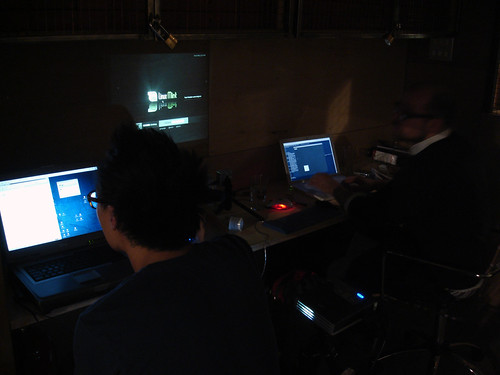
at the moment we are trying to blend the VJ workspace with the actual performance output display. by making a hybrid interface between workspace and output, Crystal will be able to construct her performance narratives in the same area where the story would unfold for the audience. this somehow reminds me of the process of making graffiti, as in graffiti the inspiration, workspace and gallery end up being the same place. as graffiti artists make the urban environment all three places at once, so should our multitouch interface.

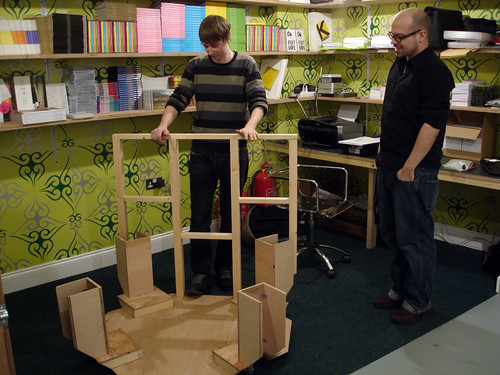
regarding hardware, Adam and i are now at the stage of putting everything together we made in the woodshop last week. Adam is my oldest friend (we’ve been friends for something like 15 years!) who came over from toronto via berlin to help me out. he happens to be a talented industrial designer and it shows in the craftmanship of the design and construction of the table. it really is well (if not over!) built.
in order for us the have full, 24h access to the table, we have moved much of the hardware to KKOUTLET so we can continue building without the encumbrance of closing times and security guards, which we were running into working at CSM. at the moment we are around 75 percent done with the construction, and hope to begin to drop in the electronics by wednesday.
Created with Admarket’s flickrSLiDR.
curious of the ever farcical “democratic” process that festers in the united states, i payed a visit to www.californiaprogressreport.com, which has a copy of the debate transcript between hillary clinton and barack obama in los angeles on the 31st of january, earlier this year.

other then it being an utterly boring and mind-numbingly mundane back-and-forth of the usual lies and malarky so akin to people of their stature (read: politicians), i was curious about the vocabulary they used. reducing the debate to weighted lists, patterns such as favorite words, key issues, etc. can be derived and speculated on. take a look for yourself and come to your own conclusions of deceit and conspiracy. i for one will not be voting for either of them, namely because i am not a US citizen and have been cursed with the nationality of being Canadian, where nation wide healthcare is forced upon its population so widely and ruthlessly that you may have heard about it in popular culture.
Clinton
able absolutely access administration affordable ago agree america american approach around barack being believe best bringing bush business california care certainly change children clear companies conditions costs country debate democratic designed differences drug effort either everyone family given going health hope house immigration imperative important instead insurance issue jobs kim lives looking lot making meet million money month obviously once party pay people plan political practical president problems program proud provide public question rates really reasons record reform respect responsibility saying senator something stand start states system tax therefore think troops united universal values voice willing work workers world years
created at TagCrowd.com
Obama
able afford against agree already america american approach argument being believe billion bit bring bush buy campaign care change chronically clinton companies costs country crisis cuts debate democrats difference drug economy eight example fact forward generally getting going government hard having health hillary immigration important influence insurance interests investment iraq issue john leadership looking lot making mandate mccain meeting million mortgage nation number otherwise paid pay people percent plan policy potentially president prevention problem provide question rates reason respect school seeing senator something special started states suggest sure system talking tax thank think understand united wants war worked workers year
created at TagCrowd.com
on my ongoing quest to back my life up, i have started a mirror of my blog using the wordpress online blog service. you can visit the villainous.biz mirror here.

i almost feel that the mirror is a better webpage then the original for various reasons. first of all, the wordpress hosted service is free, although laugingsquid has been fantastic so far in terms of value, uptime and support. the built-in theme on the mirror is much more clean and intuitive to use then the custom gridview theme i am using for my primary site. too much control makes me want to customize villainous.biz and i end up cramming as much info into it as i can, which i am beginning to think is a mistake as access to content should be paramount.

in any case i will keep both weblogs, maybe because of sheer vanity. if you have a preference let me know 🙂
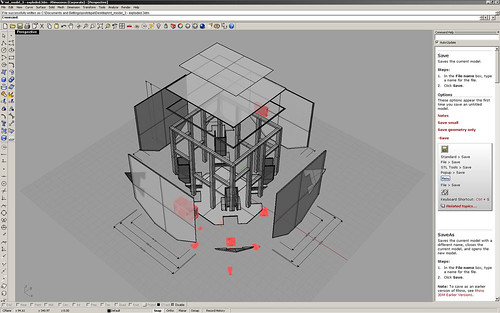
There are just some skill-sets that are absolutely coveted if you are in the creative industries. much of my final project relies on the immense skills and talent of the the people around me and that i choose (hope!) to work with. because the realization of the project i am doing is far beyond what one person can do (especially if that person is me), i have had to rely on the kindness of others. some of my collaborators are talented video artists, others are genius software developers. recently i was able to seduce an industrial designer to join our ranks and what a smooth move that has been! check out some of Adam Krause’s renders of our multitouch table project. looking at these brings a tear to my eye. i can only imagine this is reminiscent of watching the first ultrasound of your baby in the womb.


in the span of just a few days, 2 places that are close to me will never be the same.
after coming back from a friends’ birthday, karin, adam and i found ourselves standing outside camden station, just beyond the camden lock, watching blooms of smoke hit the sky. we had to make a lengthy detour to get home. looking at my phone when i reached my bed, i realized that i missed an sms from the neighbors. all it said was “camden is on fire!“.
Namdaemun gate in Seoul, South Corea is the oldest piece of history in the country. i have been working on a project with the city involving the ancient city walls, and the south gate once marked the entrance to the old city. recently opened to the public again, its burning marks a major blow to the historical commodity of the culture and nation. this also forces us who are working on the project to rethink the relevance of our proposals after such a tragic event.
no matter how far we have progressed, no matter how far technologically has advanced, no matter how morally enlightened we may become, fire always wins.
Lighting
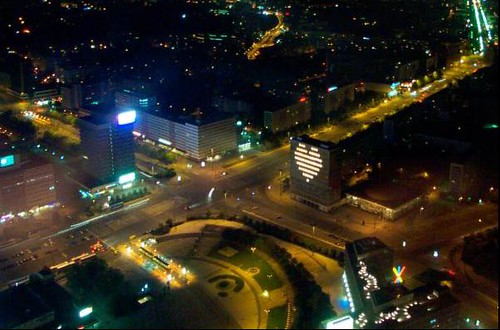
Seoul already pays much attention to lighting within the city, although projects seem to be lucid and playful now, a citywide plan or theme could provide continuity and strong identity. the first example of program for city lighting is alexanderplatz in berlin, where the ccc has been known to do their blinkenlights project:

next up is the SPOTS media facade in berlin, potsdamerplatz:
also on continental europe, rotterdam’s kpn building:
Green-Spaces
here’s a look at singapore. notice its concentration of green space in the heart of the city.

london’s green spaces are also mostly concentrated into key areas.

this differs compared to the cities of muenster and naarden, where green-space becomes a gesture of the former city wall within the urban planning.


this layout provides accessibility to green-spaces by a wider radius of city dwellers. If Seoul would adopt this continental european urban planning trend, It could provide for the city a common cross-section of park-space that links districts with automobile-alternative access. People could bike and walk from district to district within the park ring. An electric tram system or maglev train would be cool too…

Green-space within the city is freed from privileged neighborhoods and becomes accessible by all points of the city. for tourists and locals alike, it would activate the city wall as a monumental geographical feature for way-finding within the inner city.
 villainous.biz
You must be logged in to post a comment.